Understanding Google My Business & Local Search

Sources for Google Map’s Restaurant Local Listing data
 In Part 1 of this series I reviewed which directories Google is using in creating their Local Listing for Restaurants. In Part 2 I looked at their sources for reviews and ratings and its impact on ranking. In this third installment I will review the aggregate results of all data Google uses in providing information for the Local Listing in the restaurant industry and some of the implications for optimization.
Google Map’s ranking algorithm is complicated. This summary reviews Map’s sources and from that one can glean some ideas about what influences ranking. Clearly though the underlying rules rely on different weighting and factors that have yet to be determined (although we can make some good guesses).
In fact it is clear that Google Maps and the Google Organic Local Onebox results weight the same local listings differently. My simplified analysis does not (and can not) establish definitively what these relative weights are. It can however point us to the data sources that Google is using and perhaps allow us to develop models for improving rankings.
Here is a summary all the details that Google Maps captured for the search Restaurant Buffalo, NY on each listing that I analyzed:
| Restaurant Ranking | Details (# of Directories) | Referring Web Pages | Number of Reviews | Stars Rating | Business Type |
| A | 8 | 176 | 57 | 4 | Hotel |
| B | 8 | 385 | 76 | 3 | Hotel |
| C | 8 | 451 | 15 | 4 | Hotel |
| D | 5 | 156 | 37 | 5 | Restaurant |
| E | 7 | 260 | 18 | 4 | Hotel |
| F | 7 | 383 | 5 | 0 | Hotel |
| G | 4 | 73 | 29 | 3.5 | Restaurant |
| H | 7 | 81 | 26 | 3.5 | Restaurant |
| I | 5 | 57 | 25 | 5 | Restaurant |
| J | 6 | 78 | 4 | 0 | Restaurant |
| K | 2 | 12 | 2 | 0 | Restaurant |
| L | 3 | 48 | 0 | 0 | Restaurant |
| M | 1 | 55 | 3 | 0 | Restaurant |
| N | 7 | 190 | 8 | 0 | Restaurant |
| O | 3 | 28 | 10 | 0 | Restaurant |
| P | 7 | 89 | 6 | 0 | Restaurant |
There is a lot of information in this chart so here are some different ways to look at the info….
Here is are several chart views of this data:
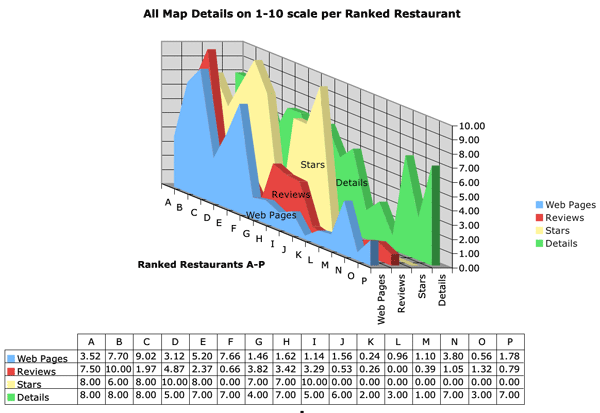
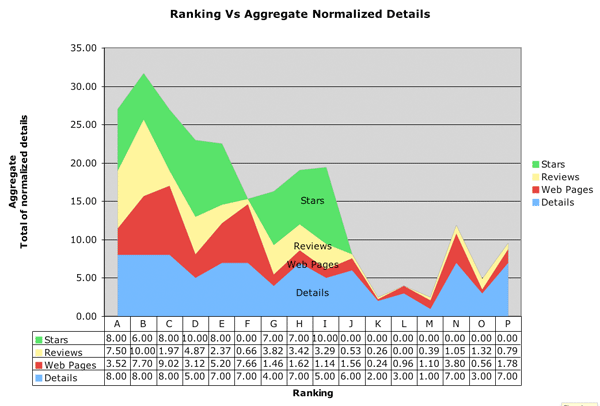
So what conclusions can one draw?
– It appears that the number of local directories in which you are listed does not confer significant ranking value beyond that critical first entry via a directory or directly via the Local Business Center (although there is probably some).
– There is a correlation between local web references, reviews and stars and ranking in Google Maps. Local web references and the total number of reviews seem to have the most impact on your Maps ranking. It is odd to me that total reviews seem to affect ranking more so than the actual star ratings. This could be an aberration of the small sample size or my statistical methodology (or lack there of) but it should be looked at further. One would think that Google Maps would reward the highest rated (on a star basis) with higher rankings. In fact this is what the Google Organic Local Onebox results seem to do…see below
-My guess here is that local web references are very important (given Google’s history). Although it is important to note that these web references typically need to have address information in them for Google to use them in this context.
-It raises the question if there is a Google Maps equivalent of Page Rank that applies to Web References and/or Review sites?
-Google Organic Local Onebox Results on the front page and Google Maps use different ranking algorithms. Note the following:
| Google Organic Top 3 Local Results | Google Maps Results |
| 1)Anchor Bar – | A.Hyatt Hotels & Resorts: Hyatt Regency Buffalo |
| 2)Kuni’s Sushi Bar | B.Adam’s Mark Hotels & Resorts |
| 3)Hyatt Hotels & Resorts: Hyatt Regency Buffalo | C.Buffalo Marriott Niagara |
| D.Anchor Bar | |
| I. Kuni’s Sushi Bar |
-In this case I agree with Bill Slawski, how could Google Maps get the top listings so wrong? Maps list 3 Hotels as 1,2 & 3 while the Google Organic local Onebox list has two of Buffalo’s better known restaurants in the 1,2 position and the Hyatt as 3 (which does have a well known restaurant on its premises). The Anchor Bar is, after all, where Buffalo Wings were first created and is a Buffalo landmark (not that I would recommend it for any one trying to eat a little healthier).
-It appears that Google Organic Local Onebox Listing ranked the only two restaurants with 5 star ratings as 1 and 2 and then took the top Google Map listing for number 3. If this is the case then those rating stars take on increased importance…Given a choice of high ranking on Google Organic local Onebox or Google Maps, I would rather be number 1 in the Onbebox on the Google Organic search results page any day.
-A minor note that is on advanced browsers, the distance measurement has been removed from the Map listing. You no longer can tell how far the restaurant you are looking at is from some arbitrary and indeterminate center point..good riddance.




© Copyright 2026 - MIKE BLUMENTHAL, ALL RIGHT RESERVED.
Comments
24 Comments
Good stuff again, Mike. Couple things I would add and comment on:
** In my interview earlier this year with Jon Glick (former Yahoo Search team member), he talked about local search and regular search using different data sets for their SERPs. The local search is more like searching a yellow pages, and things like link connectivity, authority, etc., have no impact in there like they do in the regular SERPs.
** You said: “It is odd to me that total reviews seem to affect ranking more so than the actual star ratings.” — I would think there’s a strong correlation there, in that a small number of reviews can be fudged. The restaurant owner, his/her spouse, son, daughter, staff, etc., can go out and write some great reviews giving the restaurant an inflated value on that piece of data. So the algo has to weigh quantity of reviews as heavily, if not more so, than just the value of whatever reviews it finds. For that reason, I don’t think 5-star ratings alone are strong enough to influence local search rankings.
Matt-
Thanks for your insight.
Although if you look at the Google Organic Local Listing they seem to use the same underlying data and yet they seemed to rely heavily on the star ranking…
Mike
Matt
Now that I think about “about local search and regular search using different data sets for their SERPs” the more sceptical that I am….my research has led me to believe (https://blumenthals.com/blog/?p=12) that they use exactly the same data set for the “Top 3” listings at the top of the regular serp (on a keyword + location search).
I have added some significant keywords to a business name in the Local Business Center in Yahoo and google and they have shown up in these “Top 3” results pretty quickly.
Mike – if, by “Top 3”, you’re referring to the Onebox results, I’m not including those in my prior comments as part of the “regular search” results. I’m referring just to the 10 listings you get, not the Onebox stuff at the top….
Matt-
Yes I guess I am referring to the local “Onebox” result. Just never really knew what to call it..I changed those references in the article to clarify…thanks for the input.
Mike
‘Reverse Engineering’ Google Local Results
Search engine marketer Mike Blumenthal on his blog, “Understanding Google Maps & Yahoo Local,” has been doing an interesting investigation to try and understand the Google Maps and Local algorithm(s) and what factors influence those rankings. As a ba…
[…] One of the interesting results that I covered in previous posts ( here and here ) was the occasional and glaring difference (using the same data set) of the results in the Google Onebox Local Listing and the Maps top results. […]
I have heard that standarizing your business data across the internet can help with your local rankings. The theory is that every time the SE’s find the same information about you, the more credence they give it. This seems to go along the same lines as giving higher weighting to local listings that have been “claimed” and validated by the business owner. Have you seen anything to validate this?
Hi Mary,
I’ve seen a few in some of the patent applications that Google has published this year on local search. This one is from Scoring local search results based on location prominence:
Unlike web search rankings, Google Local may be looking at mentions of a business, and seeing how many documents provide the same location information about that business as one signal in tying a business and a location together.
Certainty that a business is indeed associated with a specific location can be one of the signals being measured when determining which results to show, and which ones to show highest.
Bill/Mary
Thanks so much to both of you for your inquiries and answers.
Mary, it would make perfect sense that any local business would want consistent information across the web and that Google would “reward” that. And Bill’s patent review and my research above would validate that.
(only read on for the long answer…)
It does appear that Google makes a distinction between the structured data that it retrieves from say CityScape and the unstructured data that it gets from web pages.
It seems from what I have seen (and this is consistent with Bill’s patent research above) that what Google calls “Web Pages” when you look at “more info” about a local business certainly carries a strong correlation to better ranking in local. Those are “Web Pages” that typically have both a relationship to the category AND supply full street address information.
For example if you search under Bradford PA restaurant you find a “Web Page” named http://www.upb.pitt.edu/visitors/restaurants.htm that has (or had as it appears to be offline) the full street address to the restaurant. This characteristic appears to be broadly the case.
I imagine that Google has a system to evaluate the “value” of this reference similar to the way the Page Rank is calculated for a Link on the organic side.
My inclination is that the Local Page Rank (LPR) is a function of the importance of the site that lists your address + the page name + page content so that an address reference from one page probably confers more advantage than an address reference from another page.
That being said any web page that clearly validates your business address and type should be of help. Any page that mentions the business type in the title, headline and body copy would be better. Consistency would be key regardless.
This really has answered some questions that I was trying to figure out. I realized that organic links had some affect, but was surprised to find out that reviews had an impact.
The point about how few local businesses actually update their information is so true. We are still at the early stages of local Internet marketing. Most local businesses have yet to realize the full impact it can have on their business, whether they are retailers or service businesses.
One area that still confuses me is paid local listings on Google and Yahoo. I recently spent some time on live chat with a Google rep trying to figure out why my local paid listing showed up for some terms and not others. She was not very helpful. I know that it has to do with cost per bid, and there is some ranking consideration for your locale. But I couldn’t figure out why businesses from areas 70 miles away were getting their ads listed, and they were not even relavant.
The particular client I listed locally was a realtor in a small town. We were bidding $2.00 a click and our ads were not showing up, but unrelevant ads from businesses far away were.
Fred
Thanks for your post.
I am not a “geotargeted” ppc expert but I have sent you (under separate cover) several places where you might get that question answered.
One thing you need to realize about reviews is that are not universally impacting local results (at least not yet) because in some industries they are just not that common. I am experimenting with creating reviews in a real estate environment to test their impact where there are no previous reviews. If and when I get results I will let you know.
You also need to realize that what Google Maps calls “Web Pages” are slightly different than an organic link into your site (although I believe they are probably handled algorythmically the same). A “Web page” reference for Maps seems to need to have full address information for the business AND be easily identified as related to the industry by Google. A coupon seems to function in that capacity as well
[…] In my previous post about the sources and weightings of local information it was clear that reviews and web references played a key role in your Google Maps ranking and hopefully a business’s appearance in the top 3 One Box. […]
Fred-
I have added a post called What does a link campaign look like for Local? that you might find of interest.
Mike
[…] But close looks at the complexity of local search can be frustrating because what seems to work for an topic area like restaurants may not work well for searches for car dealers or lawyers. […]
[…] From Google’s perspective, the web site associated with that business is very important piece of information. Their Page Rank system assumes the relative importance of a web site based on the number and quality of links into the website. For Maps to work the way that Google envisions, they want to associate that a specific business with a specific website. It is not the only criteria that is used in ranking in their local product but it is a significant one. […]
[…] Normally, Google Maps uses multiple factors in their ranking: -City of Business -Verified Entry (by whatever source not qt of sources) -Authoritative Page Page Rank -Number of Web References and Page Rank of those references -Number of Reviews (not quality) […]
[…] Regarding ranking well, Mr. Blumenthal notes in Sources for Google Map’s Restaurant Local Listing data that “Local web references and the total number of reviews seem to have the most impact on your Maps ranking.” […]
[…] Some good data from Mike Blumenthal, who did some digging through Google Maps to see where they get their restaurant reviews and where they get the restaurant listing data. […]
Does anyone know a good contact at Google to speak with Rep about Google Local/Google Map results? We have a client that is #4 on Google Maps, but the #1 result is not relevant to search terms targeted…Any ideas?
Shane-
There is little to be done other than communicating with google via the “Dissatisfied? Help us improve” link at the bottom of the main results page.
A better long term strategy would be to patrons to provide more reviews and increase the number of “local” web page links (ie links that include street address etc.) so as to improve your clients standing within the standing.
Mike B
[…] Reviews play a critical role in ranking in Google Maps. However getting customers to actually write them is another story. For a client to actually find your business record within one of the large directories, identify the review link and often times register prior to leaving a review is a daunting process. Most small business owners throw up their hands in dismay at the prospects of actually getting reviews from their customers. […]
Hi Mike, it would be interesting to test of Google will weight in the rating stars if the # of reviews reach a certain number (e.g. if a business have 5 reviews, then the average stars rating should be considered in the ranking algo).
Then again like you’ve said, there are time/industry where a business rarely get any rating or reviews (because I think a lot of people don’t even know about G-map =).
[…] giving us helpful information about our surroundings that we can make meaningful use of offline.But close looks at the complexity of local search can be frustrating because what seems to work for an topic area like restaurants may not work well […]
Comments for this post are closed.